Changes in Somatosensory Cortex Explain Differences in Emotion Perception in Autism
Paper here. Abstract follows:
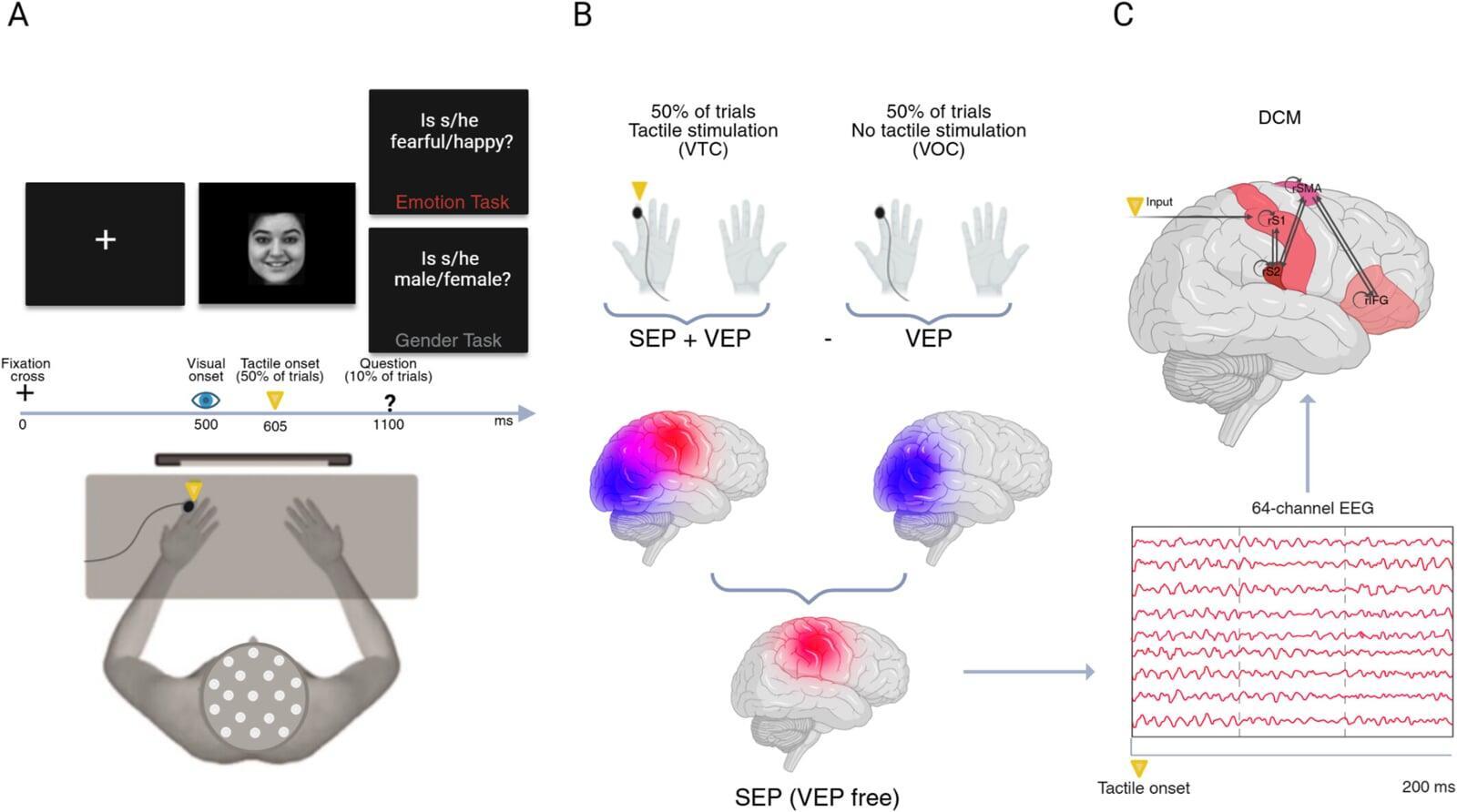
Autism Spectrum Disorder (ASD) is characterized by certain difficulties in emotion-related processing. Recent research using electroencephalography (EEG) to measure somatosensory evoked potentials during emotion perception has shown reduced embodiment of emotional expressions in autistic compared to neurotypical individuals, independently from differences in visual processing. However, the underlying neural dynamics are not clear. In this study, we use Dynamic Causal Modeling (DCM) on EEG data to investigate whether reduced embodiment during emotion processing in ASD individuals is caused by changes in intrinsic connectivity within the somatosensory cortex, or by top-down modulatory effects from higher-order frontal areas. We constructed a model involving the primary and secondary right somatosensory cortex, the right supplementary motor area and the right inferior frontal gyrus, and tested effective connectivity during emotion or gender discrimination tasks in two groups of ASD and typically developing (TD) participants (n = 38, male and female, 2 females). Our results reveal that task-related differences in electrocortical activity between the emotion and gender tasks are causally explained by changes in intrinsic activity within the right primary somatosensory cortex (rS1) in both TD and ASD. Importantly, these intrinsic changes in rS1 are significantly different between TD and ASD groups and individual task-related changes in rS1 significantly correlate with alexithymia traits. Our study provides novel evidence on the neural dynamics underlying difficulties in emotion processing in ASD individuals, highlighting that differential intrinsic activations of the rS1 are causally involved in such difficulties, and suggests that they are mediated by alexithymia.