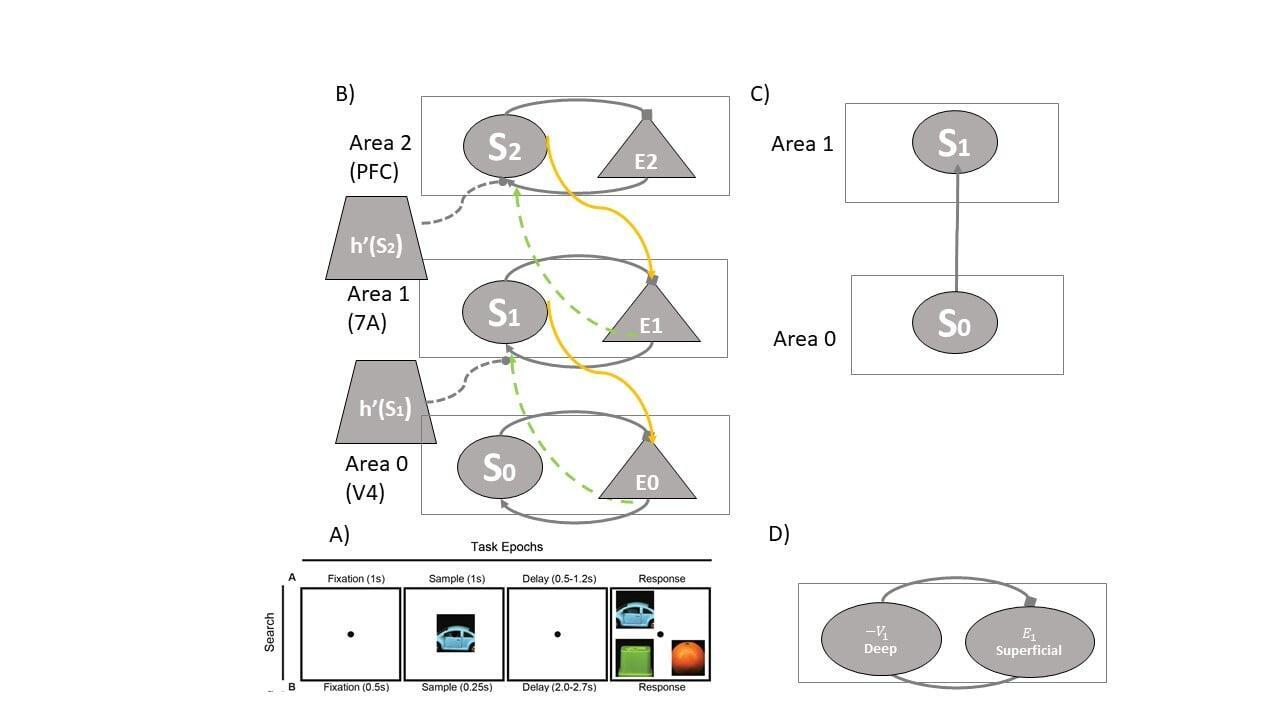
A hybrid predictive coding - routing explanation
How does the brain processes information?
This remains one of neuroscience’s most fascinating challenges.
A growing body of research suggests that the cortex functions as a predictive system—constantly generating models to anticipate incoming input. But the story isn’t that simple.
Multiple frameworks—predictive coding, routing mechanisms, and autoencoder-based models—offer overlapping explanations. The question is: which one actually reflects what the brain is doing?
In our latest work, we tackled this directly by comparing these approaches using laminar LFP recordings across a cortical network during a visual search task.
What we found was striking:
🔹 No single model fully explains neural dynamics
🔹 Instead, the brain appears to use a hybrid strategy
🔹 Deep cortical layers align with Predictive Coding principles
🔹 Superficial layers reflect predictive routing—without explicit error computations
This points toward a more nuanced view of cortical function—where complementary mechanisms operate across layers and regions, combining top-down predictions with superficial-layer inhibition.
Rather than competing theories, these frameworks may each capture part of a larger, integrated explanation. -- work with Earl K. Miller, PhDAndre Bastos